Salvage and Renovation of the Floating Dry Dock Machinist (AFDB-8)
Based on a presentation by Robert Heger at the International Dry Dock Conference.
Introduction
The salvage and renovation of the floating dry dock Machinist (AFDB-8) is a remarkable example of marine engineering, combining salvage operations, structural analysis, ballast control, and transportation logistics.
After a typhoon sank the dock in Apra Harbor, Guam, engineers faced two major challenges: refloating the structure and preparing it for renovation and recertification.
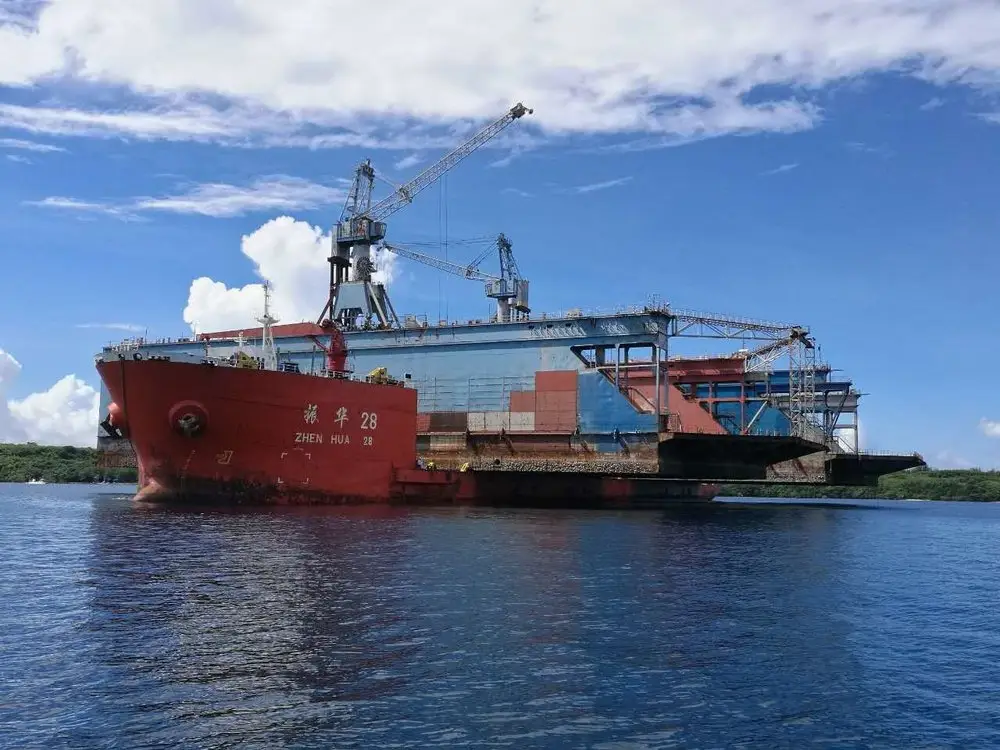
The Dry Dock
The Machinist was a large floating dry dock with the following principal dimensions:
- Length Overall: 833 ft
- Width Overall: 176 ft
- Pontoon Length: 772 ft
- Clear Width: 144 ft
- Design Capacity: 30,000 long tons
- Capacity per Foot: 55 LT/FT
Salvage Operations
Robert Heger was tasked with developing the recovery plan after the dock sank.
The operation involved restoring watertight integrity, dewatering pontoons and wing walls, and carefully monitoring drafts, deflections, water temperatures, and ballast conditions throughout the refloating process.
By integrating hydrostatic calculations with real-time field data, the team successfully refloated the dock while maintaining structural control.
The Renovation Challenge
Following salvage, the dock required extensive upgrades to increase lifting capacity and meet NAVSEA certification requirements.
Although renovation in China offered significant cost advantages, transportation created a new obstacle. The dock was too large to transport in one piece and, in its existing condition, unsuitable for towing.
An Innovative Solution
Heger proposed cutting the dry dock into two sections while afloat.
The separation was planned near amidships to minimize structural movement. Before work began, the team conducted detailed weight surveys, draft readings, displacement calculations, and deflection measurements.
Temporary ballast systems, shear beams, gap monitors, and watertight closures were installed to control structural behavior throughout the operation
The Cutting Process
The dock was separated in a carefully controlled sequence, with ballast continuously adjusted to maintain stability and replicate post-separation draft conditions.
Engineers monitored:
- Drafts
- Deflections
- Structural gaps
- Weather conditions
- Ballast levels
The final cuts were completed without measurable movement between the two sections, confirming the effectiveness of the engineering controls.
Results
The project demonstrated that a large floating dry dock can be safely sectioned while afloat through careful planning, ballast management, and structural monitoring.
The team successfully prepared the two sections for heavy-lift transport, allowing the dock to undergo renovation and recertification while avoiding the limitations of conventional towing methods.
Conclusion
The Machinist project highlights the importance of combining hydrostatic analysis, structural engineering, and practical dockmaster experience when solving complex marine challenges. From salvage in Guam to preparation for transport and modernization, the project stands as an excellent example of innovative dry dock engineering and disciplined operational execution.