HMB-1: From Secret Recovery Barge to Modern Floating Dry Dock
Based on a presentation by Glen Roberts of Bay Ship & Yacht at the International Dry Dock Conference.
Introduction
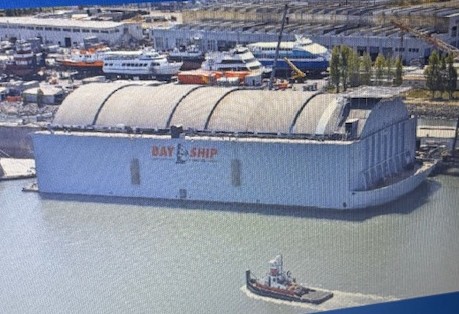
Few marine structures have a history as unique as the HMB-1. Originally built to support the highly classified Project AZORIAN submarine recovery mission, the barge later served as the construction platform for the stealth vessel Sea Shadow before undergoing a remarkable transformation into a modern floating dry dock.
Presented by Glen Roberts of Bay Ship & Yacht, the HMB-1 story highlights how innovative engineering can extend the life and usefulness of a specialized marine structure.
Origins of HMB-1
The HMB-1 was originally built as a submersible barge for Project AZORIAN, a covert effort to help the Glomar Explorer recover the sunken Soviet submarine K-129.
The barge measured:
- 324 feet overall length
- 106 feet 8 inches beam
- 19 feet hull depth
- 76 feet 8 inches well width
- Approximately 6,290 long tons displacement
Its enclosed well and submersible capabilities made it ideally suited for specialized marine operations
The Sea Shadow Era
HMB-1 later gained recognition as the construction platform and floating enclosure for the experimental stealth vessel Sea Shadow.
To support this mission, substantial structural and mechanical modifications were made to the barge. The covered configuration allowed the vessel to be constructed and tested away from public view.
For many years, HMB-1 remained closely associated with one of the most innovative naval technology programs ever undertaken.
Acquisition by Bay Ship & Yacht
Following the retirement of Sea Shadow, Bay Ship & Yacht acquired HMB-1 and began an ambitious modernization program.
The project included:
- Demolition of remaining Sea Shadow infrastructure
- Structural upgrades
- Mechanical improvements
- Sandblasting and coating renewal
- Preparation for dry dock certification
The objective was to convert the historic barge into a productive industrial asset capable of servicing larger vessels.
Conversion to a Floating Dry Dock
To meet shipyard requirements, HMB-1 was modified with several new features, including:
- Increased lifting capability
- Taller wing walls
- A retractable roof system
- A gantry crane
- Enhanced docking arrangements
These modifications enabled the facility to accommodate larger vessels while providing the flexibility of a floating dry dock.
Systems and Automation
A significant part of the conversion involved installing and modernizing automated control systems.
The upgraded facility incorporated:
- Ballast control systems
- Air supply and overpressure protection systems
- Hydraulic systems
- Wet-lock systems
- Ventilation and atmospheric control systems
- Integrated electrical and machinery controls
The result was a highly automated floating dry dock capable of operating efficiently and reliably.
Certification and Compliance
Extensive engineering evaluations were performed as part of the certification process.
These included:
- Structural assessments
- Lifting-capacity calculations
- Transverse strength analysis in accordance with ABS requirements
- Underwater inspections
- Tank examinations
- Professional engineering review and approval
The dock ultimately achieved USCG certification for dry-docking operations.
Conclusion
The HMB-1 demonstrates how a specialized marine structure can successfully evolve to meet new operational demands. Originally conceived for one of the most secretive maritime recovery missions of the Cold War, later adapted for the development of Sea Shadow, and finally transformed into a certified floating dry dock, the vessel’s history spans several generations of marine engineering innovation.
Bay Ship & Yacht’s conversion is a notable example of adaptive reuse, proving that with sound engineering and vision, even highly specialized assets can be reimagined for entirely new purposes.