
Ship Lift Transfer Systems: The Hidden Engine of Modern Shipyards
Introduction
In a modern shipyard, lifting a vessel out of the water is only the first step. Once a ship has been raised by a ship lift, it must be transported safely and efficiently to repair berths, construction areas, maintenance zones, or storage positions. The transfer system makes this critical movement possible through a sophisticated combination of transfer cars, rail networks, hydraulic equipment, structural engineering, and control technologies.
While ship lifts often receive the most attention, the transfer system is the facility’s true workhorse. It determines how many vessels the facility can handle, how efficiently it uses yard space, and how quickly maintenance or construction work can begin. A well-designed transfer system transforms a ship lift from a simple lifting device into the centerpiece of a highly productive marine infrastructure.
The challenge goes far beyond moving a vessel from one location to another. Transfer systems must support thousands of tonnes of concentrated load while maintaining precise alignment across multiple rail tracks and transfer vehicles. Every movement requires careful management of load distribution, structural deflection, synchronization, and safety controls. Even small deviations in elevation or alignment can create significant stresses within the vessel, transfer cars, or supporting infrastructure.
Modern transfer systems have evolved considerably from the early shipyard rail arrangements of the twentieth century. Today’s installations incorporate advanced hydraulic systems, automated controls, laser alignment technologies, condition monitoring, and sophisticated load management strategies. These innovations allow shipyards to handle larger vessels, improve operational efficiency, and reduce downtime while maintaining high safety standards.
Understanding transfer systems requires more than studying the transfer cars themselves. It involves examining the relationship between the ship lift, transfer vehicles, rail infrastructure, foundations, control systems, operational procedures, and vessel support arrangements. Together, these components form an integrated engineering system designed to move some of the world’s largest structures with remarkable accuracy and reliability.
This cornerstone guide explores the principles, components, design considerations, operational challenges, and future developments of ship lift transfer systems. Whether you are a shipyard engineer, naval architect, project manager, maintenance specialist, or simply interested in maritime infrastructure, this guide provides a comprehensive foundation for understanding one of the most important yet often overlooked systems in modern ship repair and shipbuilding facilities.
What Is a Ship Lift Transfer System?
A ship lift is often viewed as the defining feature of a modern ship lift facility, but its true value lies in what happens after the vessel leaves the platform. The transfer system is the engineering solution that moves ships from the lift to various positions throughout the shipyard, enabling inspection, maintenance, repair, construction, or long-term storage. Without an effective transfer system, the ship lift itself becomes little more than a sophisticated hoist with limited operational capability.
At its core, a ship lift transfer system is a transportation network designed to move vessels over land. Unlike conventional transport systems, however, it must handle extremely large loads while maintaining precise support conditions beneath the vessel. A transfer operation requires the combined action of transfer cars, rail infrastructure, foundations, control systems, and vessel support arrangements, all working together as a single integrated system.
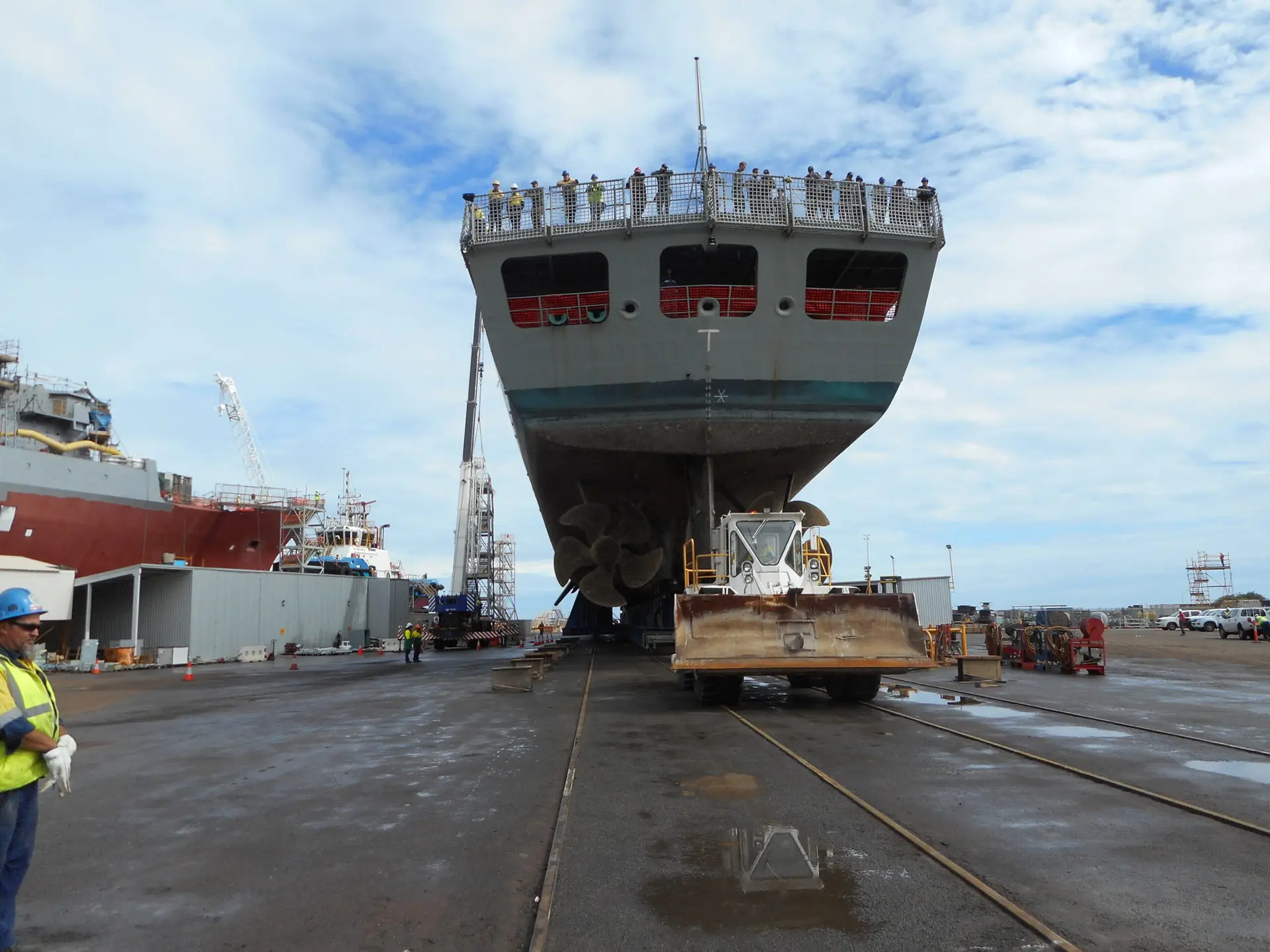
The transfer process begins when a vessel has been lifted clear of the water and positioned over a set of transfer cars. These cars, arranged beneath the vessel’s keel and supporting structure, receive the load from the lift platform and become the primary means of transportation. Once the vessel’s weight has been fully transferred, the cars travel along a dedicated rail network to a predetermined location within the yard.
The concept appears straightforward, yet the engineering complexity is substantial. A vessel weighing several thousand tonnes cannot simply be placed on wheels and moved across a yard. The load must be distributed evenly across multiple transfer cars, rail elevations must remain within strict tolerances, and movement must be coordinated to prevent excessive stress on the hull structure. Every stage of the operation must ensure that the vessel remains properly supported and aligned.
Modern transfer systems generally fall into three categories:
Transfer Systems
Longitudinal Transfer Systems
In a longitudinal system, transfer cars move parallel to the vessel’s centerline. Ships travel directly from the lift into work areas along dedicated rail tracks. This arrangement is relatively simple and efficient but may require significant yard length to accommodate multiple vessels.
Transverse Transfer Systems
Transverse systems move vessels sideways relative to their centerline. This configuration lets ships be distributed across multiple repair or construction positions, maximizing use of available yard space. Many large commercial shipyards favor transverse transfer for its flexibility and high-throughput capability.
Combined Transfer Systems
Some shipyards combine longitudinal and transverse movements. After leaving the lift, vessels may first travel longitudinally before being shifted transversely to a specific berth. These systems offer exceptional operational flexibility but require more complex infrastructure and control systems.
Regardless of configuration, all transfer systems pursue the same objective: moving vessels safely, accurately, and efficiently between the waterfront and operational work areas. The effectiveness of this movement directly influences shipyard productivity, vessel turnaround time, and overall facility capacity.
For this reason, transfer systems are not merely support equipment. They form the critical link between marine access and land-based operations. A shipyard’s ability to handle a growing workload, accommodate larger vessels, and maximize available space often depends more on its transfer system design than on the ship lift’s lifting capacity.
Key Takeaway
A ship lift removes a vessel from the water, but a transfer system determines what the shipyard can do with that vessel once it is ashore. The performance of this often-overlooked engineering system heavily influences the facility’s efficiency, capacity, and flexibility.